What is an e-bike?
Curious about the ins and outs of electric bikes? Keep reading to learn more about how they work, including details on e-bike insurance and more.
With their ability to combine the benefits of traditional bicycling and the added boost of electric power, electric bikes (e-bikes) are gaining popularity among cyclists for a variety of different uses. But what makes these innovative bikes different? Explore the growing e-bike trend with a look at what an electric bike is, the benefits they offer and considerations like insurance and laws.
What are e-bikes?
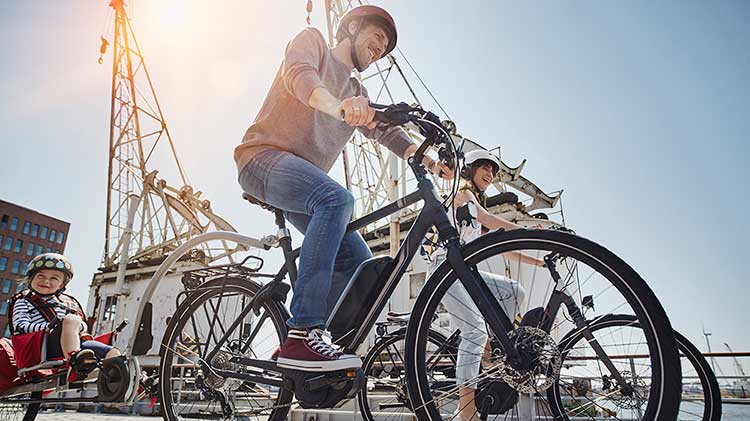
Electric bikes may appear similar to traditional bicycles, but they have one major difference: built-in batteries connected to an electric motor. This motor boosts speed and reduces the effort required from the rider. Like regular bikes, e-bikes are produced by a wide range of manufacturers and come in different styles and configurations. This includes e-bikes tailored for transporting cargo, commuter models for daily use, mountain e-bikes for off-roading adventures, foldable e-bikes designed for easy transport and more.
How do electric bikes work?
Think of an e-bike like a typical bike, but with the added assist of a motor to help you with speed and resistance. The cyclist still pedals normally, but the motor provides enhanced speed and stability. E-bikes typically offer several modes that let the user preset the power level. Some are designed to provide power only when a cyclist is pedaling, while others can be set to power without pedaling. This variety in settings and capabilities means you have more options to meet your needs. Before making a purchase, confirm the e-bike you’re considering offers the functionalities you want. If you're not familiar with e-bikes, you might be soon. Demand for e-bikes is growing, as nearly 300 million electric bikes are in use worldwide, as of 2024.
Classes of e-bikes
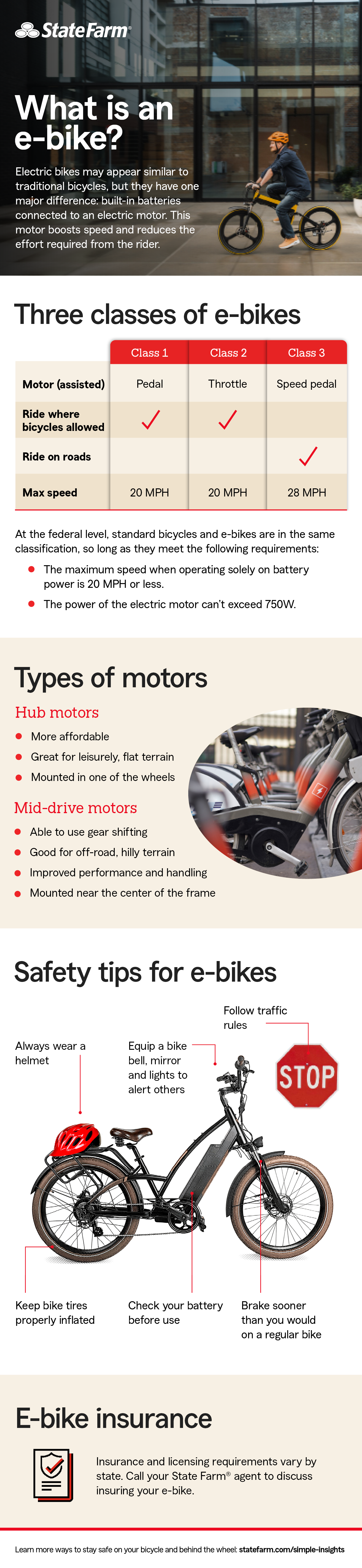
The definition of e-bike may vary by state. While not every state uses the three-tiered classification system, it is the common form of categorization for e-bikes. Please refer to local laws to determine where e-bikes are allowed. Here’s how the classes are defined:
- Class 1 e-bikes — are categorized as pedal-assisted bikes. This means the motor supports the bike’s motion only when the rider pedals first. It assists up to a speed of 20-mph, the point where the motor cuts power to prevent exceeding that speed. In pedal-assisted e-bikes, the throttle only operates when the rider is pedaling.
- Class 2 e-bikes — use a throttle-assisted system. Like Class 1 e-bikes, the throttle assistance is limited to a maximum speed of 20-mph. Unlike Class 1 e-bikes, Class 2 e-bikes provide the rider with independent control of the throttle. Practically speaking, this means you can engage the bike’s motor without needing to pedal. Once you activate the throttle, a Class 2 e-bike can be operated partially or fully by motor power at the rider’s discretion.
- Class 3 e-bikes — are the only type that exceeds the 20-mph limit. These bikes can reach a top speed of 28 mph, but they’re pedal-assisted. For battery power, cyclists must pedal to use the throttle and engage the motor.

Electric bike motor types
Almost every e-bike model uses one of two motor types: hub motors or mid-drive motors.
- Hub motors — are placed in one of the wheels, hence the name. The motor serves as the “hub” or center of the wheel where it’s installed. Connected to the bike frame via the axle, the motor spins around this axle to provide power for wheel rotation.
The simplicity of a hub motor makes it a reliable and relatively low-maintenance option. It’s popular in urban e-bike designs, known for its sturdy dependability and smooth rides as well as being ideal for daily commutes or casual enjoyment.
- Mid-drive motors — are mounted near the center of an e-bike’s frame. They employ internal gears to generate torque. These gears spin a shaft that connects to the bike’s chain. This design enables the motor to benefit from gear shifting, providing added utility that even geared hub motors typically can’t match.
The increased output of torque and motor efficiency make mid-drive motors the popular choice for racing and outdoor terrain.
Safety tips for e-bikes
Before using your e-bike, there are some important things to learn about e-bike safety. To help you get ready for your next ride, keep the following tips in mind:
- Always wear a helmet.
- Check your battery before use.
- Keep bike tires properly inflated.
- Follow traffic rules.
- Brake sooner than you would on a regular bike.
To help feel better prepared before riding in the bike lane, consider reading more about electric bike safety tips.
Do electric bikes need insurance?
While the technology has been commercially available for years, e-bikes are still fairly new to mainstream recognition, especially in the U.S. As a result, there’s some uncertainty surrounding the legal requirements for owning and riding e-bikes.
Like regular bicycles, electric bikes may not be required to have any specific registration, license or additional insurance to operate. They may use the same infrastructure as non-electric bikes, like bike lanes and any regular streets where local state law allows bicycles to operate.
If you’re unsure about your local laws on e-bikes, some organizations like the nonprofit PeopleForBikes offer guides on e-bike laws by state with research citations from each state’s legal codes. You can also look this information up directly in your state’s law code.
Depending on your state, you may or may not be considered a pedestrian if you are involved in a collision with a motor vehicle while occupying an e-bike. Further, the e-bike may or may not be considered a motor vehicle under the laws of your state. Finally, insurance coverage from your own policy or from the policy of the striking vehicle may or may not extend to injuries you sustain while occupying an e-bike.
If you elect to operate an e-bike on public roadways, understand there are risks of injury that may or may not be covered by auto insurance.
After understanding the registration and insurance requirements for your e-bike type in your state, feel free to reach out to your insurance company or a State Farm® agent. They can help you explore different policy options, like homeowners, renters, auto or other policies. Stay safe and happy cycling!
The information in this article was obtained from various sources not associated with State Farm® (including State Farm Mutual Automobile Insurance Company and its subsidiaries and affiliates). While we believe it to be reliable and accurate, we do not warrant the accuracy or reliability of the information. State Farm is not responsible for, and does not endorse or approve, either implicitly or explicitly, the content of any third-party sites that might be hyperlinked from this page. The information is not intended to replace manuals, instructions or information provided by a manufacturer or the advice of a qualified professional, or to affect coverage under any applicable insurance policy. These suggestions are not a complete list of every loss control measure. State Farm makes no guarantees of results from use of this information.
Neither State Farm nor its agents provide tax or legal advice.
State Farm Mutual Automobile Insurance Company
State Farm Fire and Casualty Company
State Farm General Insurance Company
State Farm Indemnity Company
Bloomington, IL
State Farm County Mutual Insurance Company of Texas
State Farm Lloyds
Richardson, TX
State Farm Florida Insurance Company
Orlando, FL