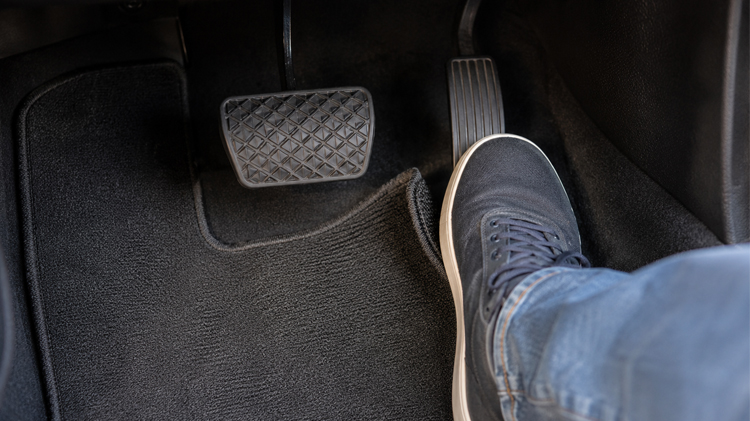
Quick steps to take if your gas pedal sticks
If your gas pedal sticks, press the brake firmly, shift to neutral and steer to a safe place. Once the vehicle stops, turn off the engine, call for assistance and consider having the vehicle inspected before driving again.
What to do if your accelerator sticks
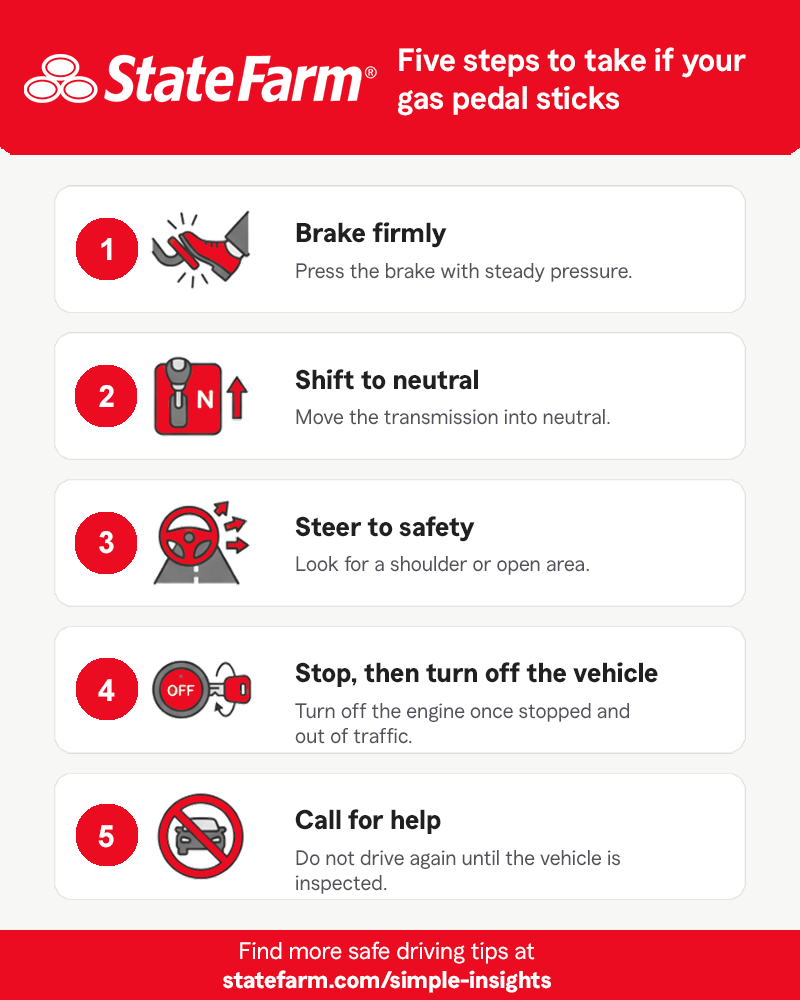

If your gas pedal or accelerator sticks while driving, try to stay focused on the road and take these steps:
- Press the brake firmly. Apply steady pressure to the brake pedal.
- Shift into neutral. Select N using the vehicle’s gear control. EVs and other vehicles with electronic shifters may use a button, dial, stalk or touchscreen; in some models, you must hold the Neutral control until the display confirms that Neutral is engaged. If you cannot engage Neutral quickly, continue firm, steady braking and focus on steering to a safe place. Consult the vehicle owner’s manual for its specific shifting procedure.
- Steer toward a safe place. Keep both hands on the wheel, look for an open area or shoulder and move out of traffic when you can. Avoid quick lane changes that could make the vehicle harder to control.
- Stop and turn off the vehicle. Once the vehicle is stopped and out of traffic, turn off the engine. If your vehicle uses a key, keep it in the ignition so the steering wheel does not lock. If your vehicle has a start on/off button, hold the button down for at least three seconds to disable the vehicle. Do not tap repeatedly. If you are unable to successfully stop the car, consider making a hands-free call to 911 for guidance.
- Call for assistance. Do not drive the vehicle again until it has been inspected by a qualified repair professional.

Vehicle malfunctions leading to unintended acceleration are rare, but one should know what to do if it occurs. However, there are other ways for this to occur and the easiest preventative step a vehicle owner can take is to ensure their floormats stay in their retention hooks and away from the accelerator pedal.” says Shawn Bennett, Senior Research Analyst at State Farm.
What not to do if your accelerator sticks
If you have a stuck accelerator, some reactions may make the situation harder to control:
- Do not reach down with your hand. Keep your eyes on the road and your hands on the wheel.
- Do not make sudden lane changes. Steer smoothly and look for a safe place to pull over.
- Do not drive the vehicle again before inspection. Call for help and have the vehicle checked before it goes back on the road.
- Do not turn off the engine unless shifting into neutral is unsuccessful. Turning off the engine will turn off the power-assist brake functions, making it harder to maneuver the car.
- Don't pump the brake pedal or release it. You will lose all your power assist, causing your brakes to become stiff and very hard. If all options are not working and there is something physically sticking the pedal, it may be necessary to safely remove the object with a foot or once stopped.
What to do after the vehicle stops
Once the vehicle is stopped and out of traffic:
- Turn off the engine.
- Use the emergency brake, if needed.
- Turn on hazard lights.
- Call roadside assistance, a tow provider or a repair facility.
- Do not restart or drive the vehicle until it has been inspected.
To help stay safe on the road, you may want to consider adding roadside assistance coverage to your policy. For more details or to get a quote, contact a State Farm agent today.
Smart throttle technology may help when your gas pedal sticks
Some new vehicles come with "smart throttle" technology, which reduces the possibility of unintended accelerations caused by mechanical failures. These computer-based systems recognize when both the brake and accelerator are being depressed. This technology will tell the engine to override the acceleration and will allow the car to keep braking, in the case that the engine is receiving acceleration and brake instructions at the same time.
Technology can help, but it does not replace knowing how to respond if your gas pedal sticks. Smart throttle systems are part of a broader group of new car safety features to consider and drivers should still check the owner’s manual for vehicle-specific instructions.
This content was developed with the help of AI and reviewed by State Farm editors.
The information in this article was obtained from various sources not associated with State Farm® (including State Farm Mutual Automobile Insurance Company and its subsidiaries and affiliates). While we believe it to be reliable and accurate, we do not warrant the accuracy or reliability of the information. State Farm is not responsible for, and does not endorse or approve, either implicitly or explicitly, the content of any third-party sites that might be hyperlinked from this page. The information is not intended to replace manuals, instructions or information provided by a manufacturer or the advice of a qualified professional, or to affect coverage under any applicable insurance policy. These suggestions are not a complete list of every loss control measure. State Farm makes no guarantees of results from use of this information.
State Farm Mutual Automobile Insurance Company
State Farm Indemnity Company
Bloomington, IL
State Farm County Mutual Insurance Company of Texas
Richardson, TX