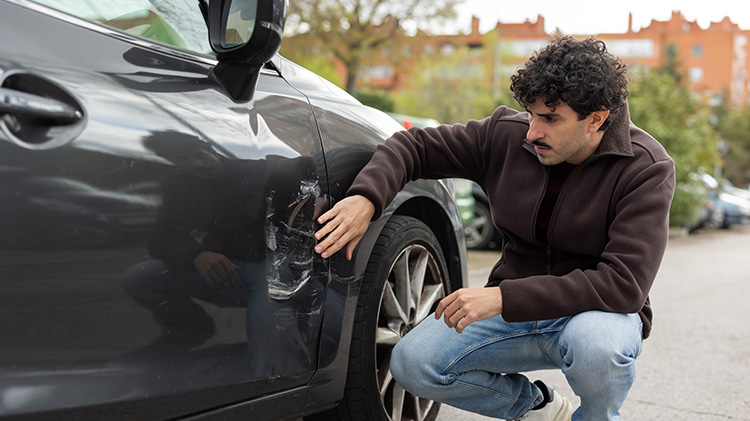
Do I need uninsured motorist coverage? The hidden risks to you when others drive without adequate insurance
Explore the hidden costs and financial risks when others lack adequate car insurance. Discover why uninsured motorist (UM), underinsured motorist (UIM) and uninsured motorist property damage (UMPD) coverage may be crucial to help protect you and your family.
Overview: Driving without adequate car insurance may lead to financial or legal consequences. If you’re in a crash with an uninsured or underinsured driver and don’t have UM or UIM coverage, you may have to pay medical bills or lost wages out of pocket. Not carrying state-required liability coverage may also result in fines, license suspension or other penalties. Depending on your state, UMPD coverage may help with vehicle repair costs when the at-fault driver has little or no insurance. This article explains coverage gaps to consider and how certain coverages may help protect your finances.
Why adequate coverage matters
Many drivers view car insurance as just another monthly expense. However, over 15% of drivers were uninsured across the U.S. in 2023, according to a 2025 Insurance Research Council (IRC) study. Millions more carry only the state minimum limits, which may not be enough to pay for all damages after a serious accident. Because some drivers may lack sufficient insurance, it’s important to carry adequate UM and UIM coverage.
This is why asking, “Do I need uninsured motorist coverage?” is so important. UM, UIM and UMPD insurance are designed to help protect you financially if you’re hit by someone who can’t pay for the medical costs or damage they cause.
Key risks and potential hidden costs
This table shows the major risks and hidden costs of driving without sufficient insurance, including UM/UIM coverage:
Let’s take a deeper dive into these three risks:
Risk # 1: Crash costs after an uninsured driver hits you
If you are hit by an uninsured driver and lack UM/UIM coverage, you may have to pay your own medical bills, lost wages and vehicle repair costs. Health insurance may cover some medical expenses, but deductibles and uncovered costs can be expensive. UM bodily injury coverage can help with these costs. Depending on your state, Personal Injury Protection (PIP) or Medical Payments Coverage (MPC or Med Pay) may also help cover medical bills and lost wages regardless of fault. Without UMPD or collision coverage, you’d be responsible for vehicle repairs caused by an uninsured driver. Collision and comprehensive coverage help cover damage to your vehicle regardless of fault, so consider discussing these options with your agent.
Risk # 2: Gaps created when relying on minimum liability limits
Many states only require minimal liability insurance. If you purchase only the state minimum limits and cause an accident, your insurance might not fully cover the costs, potentially leaving you personally responsible for the remaining damages. Similarly, if you’re hit by someone who has only minimum coverage, you could face unpaid medical bills or repairs. Carrying higher-than-minimum limits and UM, UIM and UMPD (where available) protection is recommended.
Risk # 3: Legal consequences of driving uninsured
Driving without the liability insurance required by your state is illegal and risky. Penalties may include heavy fines, license and registration suspension, possible vehicle impoundment and lasting financial consequences. While UM coverage isn’t legally required in most states, it’s an important option to help protect yourself financially if you’re involved in an accident with a driver who doesn’t have insurance. Having at least the required liability coverage can help you avoid legal trouble, and adding UM coverage can help safeguard your finances.
How UM/UIM helps protect you
UM coverage helps pay for injuries if an at-fault driver has no insurance. UIM coverage helps when the at-fault driver’s insurance isn’t enough to cover your costs.
Always check your policy and speak with your agent about your state’s rules, as UIM can vary between “difference in limits” and “difference in damages” coverage.
There are two types of UIM coverage:
- Difference in limits — pays the difference between the at-fault driver’s insurance limits and your UIM limits.
- Difference in damages — pays the difference between the at-fault driver’s insurance and the total damages you incur, up to your UIM policy limit(s).
UMPD pays for damage to your vehicle after an accident caused by a driver without insurance, but is not available in all states.
Help protect your financial future
Car insurance is more than an expense — it may be vital protection against the financial risks of uninsured motorists and other unexpected costs. Regularly review your coverage with your agent to help ensure you’re protected from these risks.
UM, UIM and UMPD coverage can help provide important financial protection against accidents caused by uninsured and underinsured drivers.
To learn more about your insurance options and risks of inadequate coverage, talk to one of our agents and get a quote online. Helping protect your future starts with having the coverage you need.
The information in this article was obtained from various sources not associated with State Farm® (including State Farm Mutual Automobile Insurance Company and its subsidiaries and affiliates). While we believe it to be reliable and accurate, we do not warrant the accuracy or reliability of the information. State Farm is not responsible for, and does not endorse or approve, either implicitly or explicitly, the content of any third-party sites that might be hyperlinked from this page. The information is not intended to replace manuals, instructions or information provided by a manufacturer or the advice of a qualified professional, or to affect coverage under any applicable insurance policy. These suggestions are not a complete list of every loss control measure. State Farm makes no guarantees of results from use of this information.
Please remember that the preceding descriptions contain only a general description of available coverages and are not a statement of contract. All coverages are subject to all policy provisions and applicable endorsements. Coverage options may vary by state. To learn more about auto insurance coverage in your state, find a State Farm agent.
This content was developed with the help of AI and reviewed by State Farm editors.
State Farm Mutual Automobile Insurance Company
State Farm Fire and Casualty Company
State Farm General Insurance Company
State Farm Indemnity Company
Bloomington, IL
State Farm Florida Insurance Company
Orlando, FL
State Farm County Mutual Insurance Company of Texas
State Farm Lloyds
Richardson, TX