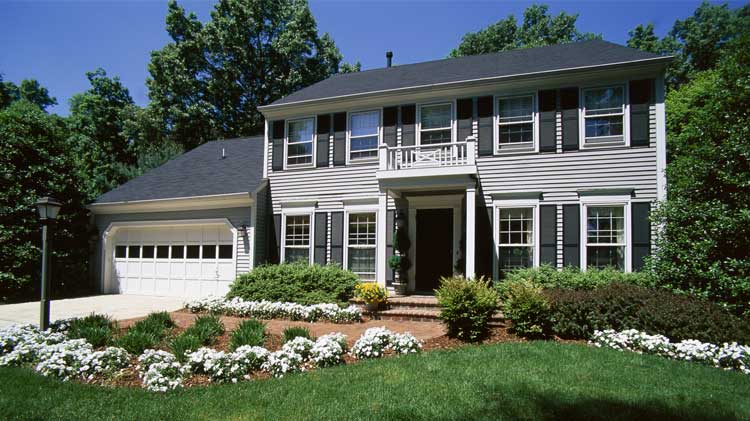
Grey two story home with black roof, front door and shutters.

What is a homeowners insurance deductible?

Learn what a homeowners insurance deductible is, how it works, when you pay it and how it can affect your home insurance premium.

Overview: A homeowners insurance deductible is what you pay out of pocket on a covered loss before your insurer pays its portion of the covered loss. It can be a set amount or a percentage of your home’s insured value and may apply per claim. Choosing a higher deductible typically lowers your premium, while a lower deductible generally means a higher premium, so it’s important to select an amount that fits your budget and financial comfort if a loss occurs. Some events, like hurricanes or earthquakes, may have separate and higher deductibles.

Get a homeowners insurance quote

Want to protect your home?


What is a homeowners insurance deductible?

A homeowners insurance deductible is an important part of your policy and can affect both your out-of-pocket cost after a covered loss and the premium you pay. An insurance deductible is the amount you’re responsible for paying toward a covered loss before your insurance company pays its portion. When you purchase your policy, you choose a deductible amount based on what you’d feel comfortable paying out of pocket if a claim happens. Depending on the policy, your deductible may be a flat dollar amount or a percentage of your home’s insured value. If you want to adjust your deductible later, review your policy options and talk with your insurer or agent about what may be available.

How does a homeowners insurance deductible work?

When you contact your insurance company about a claim, the insurer will determine the amount of the covered loss based on your policy. When the claim is paid, your deductible amount will be applied first, and the insurance company will pay its portion of the remaining covered loss.

For example, if you have a roof claim and the covered loss is $10,000, and your deductible is $1,000, you would be responsible for the first $1,000. Your insurance company would then pay the remaining $9,000, subject to your policy’s terms and limits.

In general, each time a covered claim is filed, the deductible applies. An exception may be hurricane losses, where deductibles can apply by year instead of by individual occurrence, depending on the policy and state.

When do you pay the deductible for homeowners insurance?

You do not pay your deductible when you purchase a homeowners insurance policy or simply for carrying coverage. The deductible comes into play only when you have a covered loss and file a claim.

What is the average deductible for homeowners insurance?

There is no single standard home insurance deductible, because deductible amounts can vary based on the policy, insurer and type of loss. In many cases, deductibles may be set as a flat dollar amount — such as $500, $1,000 or $2,000 — or as a percentage of your home’s insured value, such as 1% or 2%. Review your policy details to understand which deductible applies and how much you would be responsible for paying if you file a covered claim.

How does your homeowners insurance deductible affect your premium?

When choosing a policy, your deductible can be a helpful way to adjust your premium. If you choose a lower deductible, your premium will typically be higher. If you choose a higher deductible, your premium will likely be lower. Before selecting a deductible, consider how much you would feel comfortable paying out of pocket if you have a covered claim.

Deductibles for disasters

Many storms are covered by homeowners insurance, but flood insurance is typically separate, and earthquake coverage may need to be added or purchased separately, depending on the policy and state.

  • Hurricane — a special deductible may apply if a loss is caused by a hurricane. Specific triggers and policy language vary by state. Your policy language typically determines when a storm is considered a hurricane and when this deductible applies. Hurricane deductibles can be higher than standard homeowners policy deductibles, and percentages may be used instead of set dollar amounts.
  • Wind and hail — similar to hurricanes, wind and hail deductibles vary by state, especially in areas more prone to tornadoes. For wind and hail losses, percentages may be used instead of set dollar amounts.
  • Flood flood insurance is typically sold separately from homeowners insurance. Deductibles vary by policy and may be either a set dollar amount or a percentage of the home’s insured value.
  • Earthquake — earthquake deductibles may range from 2% to 20% of your home’s insured value, depending on your state and policy. Earthquake coverage may need to be specifically requested.

How to choose a homeowners insurance deductible

As you compare deductible options, think about your budget, your emergency savings and how much financial responsibility you’d be prepared to take on after a covered loss. The deductible that may work best for you is one that fits your policy and feels manageable if you ever need to file a claim.

Homeowners insurance deductible FAQs

Q: Do you pay a deductible for every homeowners insurance claim?
A: In general, a deductible applies each time you file a covered property claim. Some types of losses, such as hurricane-related claims, may have different deductible rules depending on your policy and state.

Q: What is a typical deductible for homeowners insurance?
A: A typical homeowners insurance deductible is often a set amount, like $1,000, though some policies use percentage-based deductibles for certain losses. The deductible that makes the most sense for you depends on your budget, your policy and how much out-of-pocket cost you’d want to take on after a covered loss.

Q: How does a deductible affect a homeowners insurance premium?
A: A lower deductible usually means a higher premium, while a higher deductible usually means a lower premium. That’s because choosing a higher deductible means you are taking on more of the out-of-pocket cost if you file a covered claim.

Q: Are hurricane, wind and hail deductibles different from a standard homeowners deductible?
A: They can be. Depending on your policy and where you live, hurricane, wind or hail losses may have separate deductibles. These deductibles may be higher than a standard homeowners deductible and may be based on a percentage instead of a set dollar amount.

Q: What happens if damage is less than your homeowners insurance deductible?
A:
If the covered damage costs less than your deductible, your homeowners insurance typically would not pay anything toward the claim. In that case, you would be responsible for the full cost.

Q: Can I adjust my homeowners insurance deductible?
A:
In many cases, yes. Depending on your policy terms and available options, you may be able to change your deductible after your policy is issued. An annual home insurance review can be a good time to see whether your deductible still fits your budget and coverage needs.

Q: Do renters insurance policies have deductibles?
A: Yes. Renters insurance policies typically include deductibles that work similarly to homeowners insurance deductibles. A renters policy helps cover your personal property, and if you file a covered claim, you are responsible for the deductible amount before the insurance company pays its portion of the covered loss.

This article was drafted with the help of AI and reviewed by State Farm editors.

The information in this article was obtained from various sources not associated with State Farm® (including State Farm Mutual Automobile Insurance Company and its subsidiaries and affiliates). While we believe it to be reliable and accurate, we do not warrant the accuracy or reliability of the information. State Farm is not responsible for, and does not endorse or approve, either implicitly or explicitly, the content of any third-party sites that might be hyperlinked from this page. The information is not intended to replace manuals, instructions or information provided by a manufacturer or the advice of a qualified professional, or to affect coverage under any applicable insurance policy. These suggestions are not a complete list of every loss control measure. State Farm makes no guarantees of results from use of this information.

State Farm Fire and Casualty Company
State Farm General Insurance Company
Bloomington, IL

State Farm Florida Insurance Company
Orlando, FL

State Farm Lloyds
Richardson, TX

Start a quote

Select a product to start a quote.

Find agents near
you or contact us

There’s one ready to offer personalized service to fit your specific needs.

Related articles

What is homeowners insurance and what does it cover?

When protecting your most valuable investment it's important to know if your home is properly insured for your needs. What are the policy coverages, forms and exclusions?

Understanding replacement cost vs market value

Learn the difference between replacement cost value and market value to help make an informed decision when purchasing home insurance.

Choose your car insurance deductibles and coverages well

Learn what an auto insurance deductible is and how it affects your car insurance coverage.

Why should I consider doing home insurance reviews annually?

The next time you need to renew your insurance policies, consider taking these steps to help ensure you understand what your coverages are.