Ways to help with teen driving safety
Here are tips to help your teen avoid crashes, build good driving habits and stay safe on the road.
According to a report from the Governors Highway Safety Administration (GHSA) and Ford Motor Company Fund, speeding and lack of experience are often to blame for risky teen driving behavior. This may explain why motor vehicle crashes are the leading cause of teen fatalities in the U.S.
Top 9 tips for parents of new teen drivers
- Follow graduated driver licensing (GDL) laws. These laws provide restrictions that aim to help minimize crashes and fatalities for new drivers. For example, many states have rules that prevent them from driving at night or with other teens. Know the laws in your state and possibly set stricter standards.
- Restrict night driving. According to the CDC, the fatal crash rate at night for teen drivers aged 16-19 years is roughly 3x as high as that of adult drivers. GDL laws address the issue of night driving for a reason, with decreased visibility and therefore less time to react, there is more risk.
- Keep a safe following distance. In normal driving conditions, the general rule is "three seconds plus." It is recommended that drivers begin counting when the vehicle in front passes a stationary object. The driver should reach that same object no sooner than three seconds, four seconds ideally. It is recommended that drivers allow more following distance when visibility is poor or there is traffic.
- Choose the right vehicle. When picking out a car for your teen driver there are lots of things to consider. Examine the vehicle’s safety ratings, cost and features that might help your teen such as blind spot detection and backup cameras.
- Share the car to help prevent speeding. Parents can also set a good example by practicing safe driving themselves. Even if you feel like your teen isn’t listening, they still watch your actions. Consider these good driving behaviors: wear a seat belt, don't speed, keep calm on the road, and don't talk on a cell phone or text while driving. Consider using Drive Safe & Save® from State Farm® to help monitor and support your teen’s safer driving behaviors.
- Eliminate distractions. Distractions heighten risk for new and experienced drivers alike. Your teen will probably have a cellphone with them when they drive so remind your teen of the importance of not texting and driving. Also, encourage your teen to pull over when making a phone call or when sending a text. Even while using a handsfree device or Bluetooth, a phone call can be distracting. Also be aware that in some states it is illegal to use a Bluetooth device for drivers under 18 years of age. Confirm with the Department of Motor Vehicles if that law applies to the state you live in.
- Discuss consequences. Teenage speeding or drinking and driving puts lives and licenses on the line. It can also be expensive, and tickets can increase insurance premiums. Consider setting consequences or creating a formal agreement within your own household, such as a zero-tolerance policy for impaired driving, may also encourage your teen to practice safe driving habits.
- Give ample time. Encourage your teens to give themselves plenty of time to get to their destinations. Traffic or an unexpected delay may potentially lead to speeding or an accident.
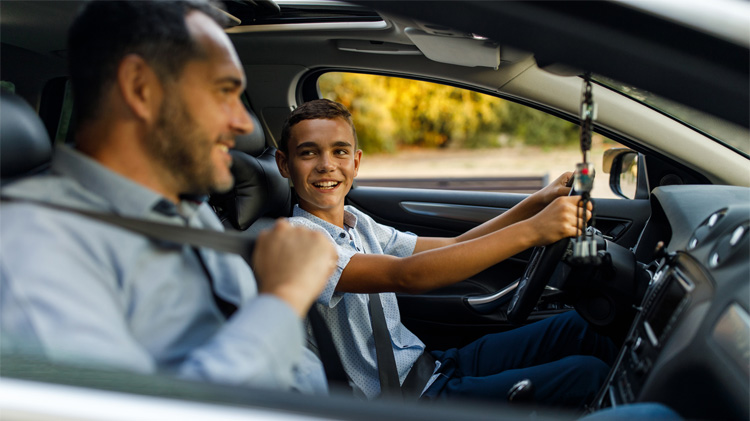
- Be involved. Frequently ride with your teens to confirm they're being safe. Brush up on what may have changed since you started driving so you can best help your teen. As your teen becomes more experienced, practice driving in the evening, during rain or snow, and in traffic so your teen can be more prepared to drive independently.
Top 6 tips for teen passenger safety
When teens start driving, chances are their teen friends are learning to drive too — so at some point your teen is likely to be a passenger in a car driven by someone without much experience. According to the CDC, the risk of a teen having a car accident increases when they have teen or young adult passengers with them. And one of the leading causes of death in teens is car accidents. During 2023, 59% of teen passenger fatalities happened when another teenager was driving, according to statistics from the Insurance Institute for Highway Safety (IIHS).
Teen passengers can help lower this risk by limiting distractions, respecting the driver and wearing a seat belt. Here are some quick tips for teaching your teens to be safety-minded passengers:
- Talk about how to be a safe passenger. Distracted driving is a major cause of crashes, and passenger distractions are particularly dangerous for new drivers. Discuss helpful passenger behaviors such as reading directions when asked and respecting the driver by not talking loudly, chatting on a cell phone, playing loud music or acting disruptively.
- Insist on seat belts. According to the National Highway Traffic Safety Administration (NHTSA), in 2023 53% of teenage drivers who died weren't wearing seat belts. Explain that by buckling up, they'll help protect their friends' lives, as well as their own because in a crash, an unrestrained body can hurt others in the car.
- Don't let your child ride with a driver who has less than a year of experience. Even the most mature teen needs time to gain driving experience through adult-supervised driving. According to DMV.org, some studies show that the risk of teens getting into accidents increases when they have passengers in the car, and that inexperienced drivers get distracted easier when driving with younger passengers like friends and siblings.
- Pay attention. To help them make good safety decisions, keep the lines of communication open. Know where they are going and why, and discuss how they will get there and when they will be home. Provide alternatives, like rides, to help them avoid unsafe driving situations.
- Create a code word. Help teens get out of unsafe situations by having them call or text you with a previously agreed-upon code word that signals trouble. When you hear or see the word, pick them up right away.
- Do not ride with substance-impaired drivers. Remind your teen to not get in a car with any driver who is impaired due to alcohol or any other substance. Drunk driving is not only illegal, but it can be fatal. In 2023, 12,429 people were killed in traffic accidents that involved drunk drivers, according to NHTSA. In addition, encourage your teen to make smart choices when leaving prom and graduation parties.
Learn more about teen driver safety and tools for new drivers with these additional tips. And feel free to reach out to a State Farm® agent if you want to learn more about car insurance for teens and new drivers.
The information in this article was obtained from various sources not associated with State Farm® (including State Farm Mutual Automobile Insurance Company and its subsidiaries and affiliates). While we believe it to be reliable and accurate, we do not warrant the accuracy or reliability of the information. State Farm is not responsible for, and does not endorse or approve, either implicitly or explicitly, the content of any third-party sites that might be hyperlinked from this page. The information is not intended to replace manuals, instructions or information provided by a manufacturer or the advice of a qualified professional, or to affect coverage under any applicable insurance policy. These suggestions are not a complete list of every loss control measure. State Farm makes no guarantees of results from use of this information.
Discounts may exceed 30% & vary state-to-state (NY capped at 30%). Not available in CA, MA & RI. Discount available in NC, depending on facts. Setup required.