Boating safety tips
Help stay safe on the water by being prepared with these boat safety tips.
Understanding the basics of boating safety is crucial before you hit the open waters. In 2023, the U.S. Coast Guard reported 3,844 boating accidents, resulting in 564 deaths. Whether using a boat for fishing, swimming, water skiing or simply cruising with your family and friends — it's important to know the rules, requirements and boating safety recommendations. Regardless of experience, consider reviewing the following boating essentials.
Inspect your boat
Before you get on the water, see that your boat is seaworthy by scheduling a U.S. Coast Guard Vessel Safety Check. This courtesy evaluation is a free and convenient way to help check your boat's compliance with state and federal boating equipment regulations. And don't forget to inspect your boat trailer as well.
Have an agent contact me
with a quote
Take a boat safety course
Education is vital when operating a boat and can help save lives. According to the U.S. Coast Guard 2023 report, 75% of deaths occurred on boats where the operator did not receive boating safety instructions. The knowledge gained from these courses can help save lives and help reduce injuries and property damage.
In the United States, 36 states require operators to take an approved boating safety course as part of their boat licensing or safety certification process. A boat safety course will teach basic marine operation, navigation and safety, as well as federal and state boating regulations and waterway rules.
Know the boating rules of the water
Just like when driving a car there are rules of the road, driving a boat brings its own set of rules. Here are some examples.
- When two motorized vessels look to cross in the water, the give-way vessel (the boat that has the other boat on its starboard/right side) should slow down and/or cross behind the stand-on vessel (the boat that must maintain its course and has the right of way).
- When overtaking another boat (coming from behind and passing), the give-way vessel can pass on either side of the stand-on vessel.
- Boaters have a responsibility to operate their vessel at a safe and controlled speed for the situation.
- Avoid boating too close to other boats.
- Do not operate a boat while under the influence of alcohol or drugs. Boating under the influence can have serious legal consequences just like driving a car while intoxicated.
Be prepared with a boat safety equipment checklist
You can't always prevent emergencies on the water, but you can help be more equipped to deal with them effectively. The U.S. Coast Guard suggests you have the following items on your boat:
- U.S. Coast Guard-approved life jackets (in the appropriate type and size for each person on board)
- Fire extinguishers
- Distress signals and sound devices (flares, orange flag, mirror, air horn and whistle)
- VHF radio equipment
- Charts of the local area
- Compass
- Anchor and extra line
- Tool kit for repairs
- Paddles
- Bailer or bilge pump
- Flashlight
- Spare battery
- First-aid and emergency kit
- Bucket
- Food and water
- Additional clothing (such as warm clothes, a hat and severe weather gear)
- Personal items (sunscreen, medicines and sunglasses)
Always wear a life jacket
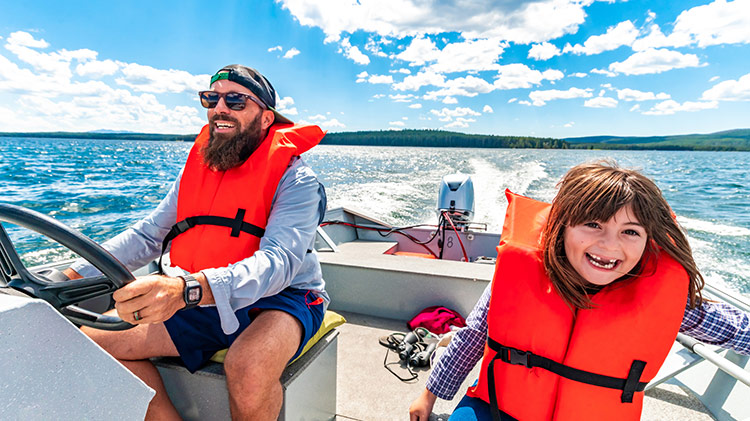
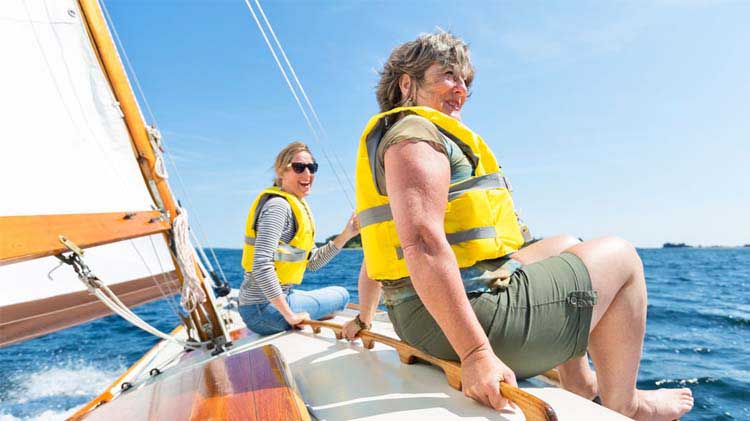
It doesn’t matter how well you can swim or the proximity to shore, wearing a life jacket is one of the most important things you can do before stepping on a boat. The U.S. Coast Guard reported that 75% of fatal boating accident victims drowned. Of the victims who drowned, 87% were not wearing a life jacket. The importance of wearing a life jacket cannot be said enough. Check the size and weight requirements to ensure your life jacket fits properly.
Consider these boating basics
- Check the weather — consult local forecasts before heading out, especially during hurricane season. If you hear thunder, see storm clouds or lightning while boating, return to dry land and seek shelter as soon as you can.
- Dress appropriately — if boating during colder-weather months, know that cold water can be dangerous. Bring extra clothes in case you get wet.
- Appoint an assistant skipper — don't be the only person on your boat who knows how to operate the vessel and where the safety and first aid equipment is stored.
- Research where you’re going — learn the local boating speed zones and know where you’re going before you take off.
- Have communication options — in addition to a VHF radio, bring a mobile phone sealed in a water-resistant bag.
- Leave a float plan — before you head into the water, let someone on land know where you're going and when you plan to return.
- Know the maximum capacity — do not exceed the maximum number of people or weight for the watercraft. This information can be found on the capacity plate.
- If you can't swim, take lessons — even a few fundamental swimming lessons could someday mean the difference between living and drowning.
- Use a kill switch lanyard — on power boats and personal watercrafts, this simple tether between you and the ignition key shuts the engine off if you fall overboard or lose your balance while driving — helping reduce the potential for harm to you or others in the water.
- Protect against propeller strikes — account for all passengers before starting the engine, and wear your emergency cut-off switch at all times. When people are in the water, ask one person to propeller-watch. You may also want to consider propeller-safety devices, such as guards or sensors.
- Be aware of carbon monoxide — all internal combustion engines produce carbon monoxide — an odorless, colorless and poisonous gas. Poor cabin ventilation, blocked exhaust outlets and faulty equipment can contribute to the problem.
- If your boat capsizes, stay with it — the boat may help provide flotation assistance and it can also be easier for rescuers to spot.
- Don't boat under the influence (BUI) — the use of alcohol was involved in about 17% of recreational boating fatalities, according to the U.S. Coast Guard in 2023.
Purchase boat insurance
Your home, your car and your boat are all investments worth protecting, and that means buying boat insurance. Contact a State Farm® agent to discuss potential discounts and your boat insurance coverage options before you put your boat in the water.
The information in this article was obtained from various sources not associated with State Farm® (including State Farm Mutual Automobile Insurance Company and its subsidiaries and affiliates). While we believe it to be reliable and accurate, we do not warrant the accuracy or reliability of the information. State Farm is not responsible for, and does not endorse or approve, either implicitly or explicitly, the content of any third party sites that might be hyperlinked from this page. The information is not intended to replace manuals, instructions or information provided by a manufacturer or the advice of a qualified professional, or to affect coverage under any applicable insurance policy. These suggestions are not a complete list of every loss control measure. State Farm makes no guarantees of results from use of this information.
State Farm Mutual Automobile Insurance Company
State Farm Fire and Casualty Company
State Farm General Insurance Company
State Farm Indemnity Company
Bloomington, IL
State Farm County Mutual Insurance Company of Texas
State Farm Lloyds
Richardson, TX
State Farm Florida Insurance Company
Orlando, FL