House shopping: Rent vs. buy?
Weigh the renting vs. buying pros and cons to determine which option makes sense for you.
“Should I rent or buy?” That's the big question you’ll want to ask yourself before you go house shopping. The answer to that question depends on your priorities. For example, do you want to build equity or do you need to relocate easily? Understanding the benefits of renting vs. owning may assist you when making a decision.
Things to consider before you rent or buy a house
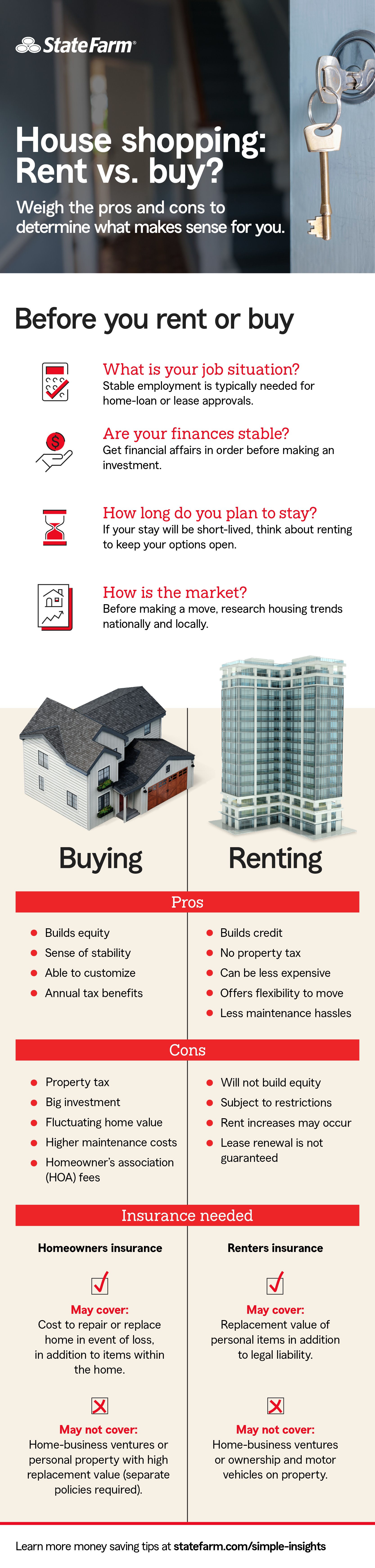
- What is your job situation? A stable job isn’t only important for paying off costs associated with rental properties or home mortgages, it’s typically a requirement to get approved for a lease or home loan in the first place.
- Are your finances stable? Getting your financial affairs in order is wise before making a significant investment. This may be especially beneficial if you decide to buy, as it may give you a head start on saving for a down payment.
- How long are you planning to stay? If you anticipate a need to move in the near future, either for work or personal reasons, think about renting for the time being to keep your options open.
- How is the market? This can vary both nationally and locally. Before investing, do some research into the trends affecting the market. Note that this also affects rentals, so you’ll also want to research rental trends for a comparison.
Pros and cons of buying a house
Pros of buying a house
- Equity — houses build equity over time, and homeowners can borrow against the accumulated equity.
- Customize — owners can customize the look, feel and layout of the home without asking permission.
- Tax — homeowners can claim annual tax benefits like deductions for mortgage interest and property taxes.
- Stability — owning a home can provide a sense of stability and allow you to get roots in a community, which can be especially beneficial to those with families.
Cons of buying a house
- Maintenance expenses — the higher maintenance costs associated with owning a home are the homeowner's responsibility and there may be repairs that need to be made upon purchase. The additional costs associated tend to make homeowning more expensive in general.
- Homeowner’s association (HOA) fees — these fees may be included as an additional cost of ownership to cover maintenance in common areas and upkeep.
- Home value — this may fluctuate with the economy and it’s possible to lose money on your house in the long run.
- Savings — when you buy a home, you may be investing a large chunk of your cash — money that can no longer be flexibly used on other purchases.
- Tax liability — while you may receive some tax benefits, homeowners still need to pay property tax, which is an additional cost that renters don’t incur.
Overall, buying is typically good for those that have a good credit score, a good amount saved and a well-paying stable job.
Homeowner insurance needs
Homeowners insurance may cover the repair or replacement cost in the event of loss and may also cover the value of the items within the home.
Pros and cons of renting a house
Pros of renting a house
- Flexibility — renting offers flexibility if you want to move, depending on the landlord and lease.
- Affordable — renting can be less expensive than a down payment on a home and mortgage — sometimes there’s even room to negotiate.
- Maintenance — renters may not need to deal with maintenance hassles as they are usually the responsibility of the landlord.
- Credit — renting can be a great way to build credit, which may give you a better chance of securing a loan in the future.
- Taxes — renters are not required to pay property taxes which increases the short-term benefit of renting if taxes are high.
Cons of renting a house
- Restrictions — renters may be subject to restrictions on with pets, home customization or guests staying longer than a week.
- Expenses — renters may also experience rent increases compared to fixed-rate mortgage payments.
- Leases — certain rentals may not renew when a lease expires, so you may have to look for a new place to live earlier than you’d like to.
- No equity — renters don’t build equity over time with rent payments. Equity goes to the owner instead.
Overall, renting is good for those that prefer flexibility and need a bit more time to grow savings, increase income and establish solid credit scores.
Renters insurance needs
Renters insurance may cover the value of personal items within the property in addition to legal liability. However, it may not cover home-business ventures or vehicles on the property.
Ultimately, whether you choose to rent or buy, consider your long-term goals, financial situation and lifestyle needs to make a decision that works for you. Depending on what you decide, consider contacting a State Farm® agent if you want to learn more about homeowners or renters insurance.
The information in this article was obtained from various sources not associated with State Farm® (including State Farm Mutual Automobile Insurance Company and its subsidiaries and affiliates). While we believe it to be reliable and accurate, we do not warrant the accuracy or reliability of the information. State Farm is not responsible for, and does not endorse or approve, either implicitly or explicitly, the content of any third party sites that might be hyperlinked from this page. The information is not intended to replace manuals, instructions or information provided by a manufacturer or the advice of a qualified professional, or to affect coverage under any applicable insurance policy. These suggestions are not a complete list of every loss control measure. State Farm makes no guarantees of results from use of this information.
State Farm Mutual Automobile Insurance Company
State Farm Fire and Casualty Company
State Farm General Insurance Company
State Farm Indemnity Company
Bloomington, IL
State Farm County Mutual Insurance Company of Texas
State Farm Lloyds
Richardson, TX
State Farm Florida Insurance Company
Orlando, FL